The Difficulty of Being Good:

On the Subtle Art of Dharma

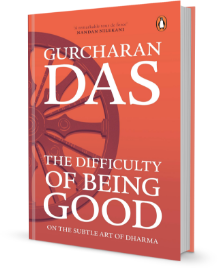
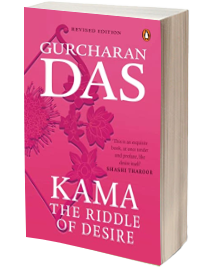
The Difficulty of Being Good: On the Subtle Art of DharmaGurcharan Das

Penguin Books India
ISBN: 9780670083497
August 2009

Brief description of the book:

Most of us spend our lives wrestling with day-to-day questions of right and wrong and these either unanswered or have no easy answer. This book turns to the Sanskrit epic, Mahabharata, in order to answer the question, ‘why be good?’ and it discovers that the epic’s world of moral haziness and uncertainty is closer to our experience as ordinary human beings rather than the narrow and rigid positions that define most debate and discussion today after 9/11. … More

Read Book reviews:

Read Opinion of Experts:

Listen to conversations on the book (telecasted on Bloomberg UTV):

Read Excerpts from the Book:

Read Articles related to this book:

Read foreword by author to:

Buy this book:

………………………………………………………………………………………………………………


‘The book is a wonderful combination of the scholarly and the personal, the academic and the meditative. The basic plan works beautifully, building a rich mix of his very, very careful and detailed reading of the text, his other wide reading, and his life in business; an extraordinary blend. I found the use of evolutionary biology and the Prisoner’s Dilemma to explain the pragmatism of the Mahabharata absolutely brilliant.’

—Wendy Doniger is the Mircea Eliade Professor of the History of Religions, University of Chicago.

^Top

‘The book is a remarkable tour de force that connects an ageless philosophical epic to the travails of contemporary society. This book is for the liberal Hindu who does not want his religion co-opted, for the modern Indian who wants to build a fair and inclusive society and for the global citizen who is rendered asunder by moral absolutism. The dharmic challenges we face every day resonate throughout Gurcharan’s book. Reading this book has been an enriching experience! ‘

–Nandan Nilekani, author of ‘Imagining India’

^Top

‘Through a series of bravura readings of the Mahabharata, Gurcharan Das makes a learned and passionate attempt to inform how the great Indian epic might illuminate our present-day moral dilemmas. Readers will find his analyses of dharma insightful, challenging, and honest–doing full justice to the world’s most complex, exciting and honest poem.

This admirable book offers precisely the kind of reflection that the epic itself invites—moral, political and public. It shows why the Mahabharata is a classic: because it is ever timely. This superb book is knowledgeable, passionate, and even courageous. Grounded in a secure knowledge of the narrative, it raises key moral problems—from the doctrine of just war to affirmative action to the nature of suffering– and it makes striking attempts to link these with contemporary discussions and issues, both public and personal.’

–Sheldon Pollock is William B. Ransford Professor of Sanskrit and Indian Studies, Columbia University, and author of The Language of the Gods in the World of Men: Sanskrit, Culture, and Power

^Top

‘What a wonderful gift Gurcharan Das is to this world! His scholarship, thorough research and extraordinary power of expression make this book unputdownable.’

–Narayana Murthy, founder Infosys Ltd

^Top

‘I was very moved by this richly articulated, contemporary meditation on the Mahabharata and the great human themes it embodies– above all the question of what life means and what one might do to endow it with purpose, within the inherently ambiguous and painful contexts in which we always find ourselves. The book is a kind of miracle: a deeply sensitive man suddenly decides to leave his usual routines and familiar roles and to spend some years simply reading the Mahabharata and seeing what the ancient epic has to tell him; he engages profoundly with the text, with the bewildering profusion of its messages, its tormented heroes, and the dramatic events it describes; and he then finds the space and the right words for a thoughtful, highly personal, philosophically informed, skeptical, sustained response. Such things happen only rarely in our generation, and we should all be grateful to Gurcharan Das for this gift.’

–David Shulman, Renee Lang Professor of Humanistic Studies, The Hebrew University of Jerusalem.

^Top

‘This book is a triple treat. It provides a subtle reading of episodes in the Mahabharata. It uses those readings to raise consistently provocative questions about the character of dharma. And it addresses important questions about the character of our ethical lives…It wears its learning lightly, prompting one to think, and hence it is a pleasure and a provocation.’

–Pratap Bhanu Mehta, political scientist and president, Centre for Policy Research, New Delhi

^Top

‘This wise, passionate, and illuminating book is one of the best things I’ve read about the contribution of great literature to ethical thought.’

–Martha Nussbaum, Professor of Philosophy, University of Chicago

^Top

‘Story telling is an ancient art in India but the stories always had a higher moral purpose. Gurcharan Das has mastered both the art and the purpose. In this elegantly written book, he weaves many tales, both personal and epic, to present a moral philosophy for individuals, corporations, and governments of the 21st century.

The recent global economic crisis has revealed deep corruption and lack of moral insight at the highest echelons of the economy… showing that is difficult to be good, a constant moral struggle exemplified in the characters of the Mahabharata and in the stories and moral tales narrated with such charm and force by Gurcharan Das.’

–Patrick Olivelle, Chair in the Humanities, Professor of Sanskrit, University of Texas

^Top

‘Gurcharan Das’ personal search for dharma in the ancient epic uncovers buried signposts to a desirable future polity. The Difficulty of Being Good is a significant Indian contribution to a new, universal Enlightenment that is not Western in origin or character. It is a delight to read a book that wears its learning so elegantly and presents its arguments with such panache.’

–Sudhir Kakar, author and psychoanalyst

^Top

‘It took me on a huge intellectual and emotional journey. And with Gurcharan Das as guide, even familiar paths seemed to lead through fresh landscapes….The secular humanism and intellectual humility that shines through this beautiful book shows that — along with everything else– the Mahabharata can provide just what the modern world needs. Das’ rehabilitation of Yudhishthira is inspiring… showing convincingly that [others] misunderstand his role. I came away feeling more whole.’

–Dr Ian Proudfoot, Sanskrit scholar, Australian National University

^Top

‘Gurcharan Das is a delightful story teller. He also invariably has a point.’

–Rajat Kanta Ray, Historian and Vice-Chancellor, Visva Bharti, Shantiniketan

^Top

‘This book has done the rare thing of successfully invoking the Mahabharata to help address the questions that one faces in one’s life. Unlike many attempts to make the Mahabharata “relevant” to modern life, this one takes the text seriously as a historical document and does not gloss over the explicit uncertainties and uncomfortable ambiguities that the text conveys. It is written in the expository memoir style that Gurcharan Das used so effectively in India Unbound. The style personalizes the questions and the quest for answers. It makes the work come alive and holds one’s interest throughout. The added service that the author provides is to show how the authors of the Mahabharata engaged the same sorts of central ethical issues (with sometimes remarkably similar responses) as Western thinkers both ancient and modern.

This book is a work of great insight. The Sanskritist, the philosopher, and the intelligent lay reader will all benefit from spending time with this work. There are few works on classical Indian thought for which this is true. Das is to be congratulated for so effectively speaking to such diverse audiences.’

–Richard W. Lariviere, Prof. of Sanskrit and Provost and Vice Chancellor, University of Kansas.

^Top

‘The Mahabharata is one of the outstanding achievements of the human intellect and imagination and Gurcharan Das addresses its moral conflicts based on a close reading of classical texts and an informed understanding of modern philosophical arguments, making this book both instructive and enjoyable.’

–Andre Beteille, FBA, Professor Emeritus of Sociology, University of Delhi.

^Top

‘The book is entertaining and thought-provoking, and will help many people see connections between the Mahabharata and contemporary issues–even when they encounter the epic for the first time. It is a book for both those for whom it has always been part of their cultural memory and for those who are reading it for the first time this critical composition from India’s rich and complex history. It offers insights and suggestions even for scholars of Indian thought, literature and history.”

–Chakravarthi Ram-Prasad, Professor of Comparative Religion and Philosophy, Lancaster University

^Top

‘Plato famously sought to dethrone the epic poets from their station as educators in morals and ethics. In India, by contrast, the great epics, the Mahabharata above all, have been forever unassailed in their authority as teachers and interpreters of the human condition. Curiously, however, their messages for moral philosophy have been slow to emerge in the field of contemporary thought. With this new book, essayist and playwright Gurcharan Das guides us through the moral contours of the epic world with analytical insight and literary panache. In doing so, he reveals vistas enlarging our understanding not just of the past, but, most importantly, of the moral dilemmas we face today.

–Matthew Kapstein, Numata Visiting Professor of Buddhist Studies, The University of Chicago, and Directeur d’études, Ecole Pratique des Hautes Etudes, Paris

^Top

………………………………………………………………………………………………………………

Nandan Nilekani
(1/3) (2/3) (3/3)
^Top
Ashis Nandy
(1/3) (2/3) (3/3)
^Top
Jerry Rao
(1/3) (2/3) (3/3)
^Top
Arun Maira
(1/3) (2/3) (3/3)
^Top
Salman Khurshid
(1/3) (2/3) (3/3)
^Top
Kiran Karnik
(1/3) (2/3) (3/3)
^Top

………………………………………………………………………………………………………………

Brief description of the book:

Most of us spend our lives wrestling with day-to-day questions of right and wrong and these either unanswered or have no easy answer. This book turns to the Sanskrit epic, Mahabharata, in order to answer the question, ‘why be good?’ and it discovers that the epic’s world of moral haziness and uncertainty is closer to our experience as ordinary human beings rather than the narrow and rigid positions that define most debate and discussion today after 9/11.

The Mahabharata is obsessed with the elusive notion of dharma—in essence, doing the right thing. When a hero does something wrong in a Greek epic, he gets on with it; when a hero falters in the Mahabharata, the action stops and everyone weighs in with a different and contradictory take on dharma. The epic’s characters are flawed; they stumble. But their incoherent experiences throw light on our day to day emotions of envy, revenge, remorse, status anxiety, compassion, courage, duty and other moral qualities. As the Mahabharata’s story unfolds in each chapter (and the author lets the epic speak as far as possible), the focus moves to a single character and his or her ethical problem–and its significance for our lives.

The classical Indian life has four aims. Gurcharan Das’ earlier book, India Unbound, examined the aim of artha, material well being. This one dwells on the goal of dharma, moral well being. It addresses the central problem of how to live our lives in an examined way–holding a mirror to us and forcing us to confront the many ways in which we deceive ourselves; how we are false to others; and how we oppress fellow human beings. Its premise is that ordinary human life does not have to be so cruel and humiliating.

The author studied moral philosophy with John Rawls and Sanskrit with Daniel Ingalls at Harvard.

^Top

Gurcharandas.Org site is Powered by WordPress with Pool Theme  managed by Center for Civil Society.
^Top^