<?xml version="1.0" encoding="UTF-8"?>
<rss version="2.0"
	xmlns:content="http://purl.org/rss/1.0/modules/content/"
	xmlns:wfw="http://wellformedweb.org/CommentAPI/"
	xmlns:dc="http://purl.org/dc/elements/1.1/"
	xmlns:atom="http://www.w3.org/2005/Atom"
	xmlns:sy="http://purl.org/rss/1.0/modules/syndication/"
	xmlns:slash="http://purl.org/rss/1.0/modules/slash/"
	>

<channel>
	<title>Gurcharan Das (Official Website)</title>
	<atom:link href="http://gurcharandas.org/?feed=rss2" rel="self" type="application/rss+xml" />
	<link>http://gurcharandas.org</link>
	<description>An Author, Management Guru and Public Intellectual</description>
	<lastBuildDate>Tue, 31 Aug 2010 15:15:24 +0000</lastBuildDate>
	<language>en</language>
	<sy:updatePeriod>hourly</sy:updatePeriod>
	<sy:updateFrequency>1</sy:updateFrequency>
			<item>
		<title>Twelve city book tour in USA</title>
		<link>http://gurcharandas.org/?p=462</link>
		<comments>http://gurcharandas.org/?p=462#comments</comments>
		<pubDate>Wed, 25 Aug 2010 09:31:47 +0000</pubDate>
		<dc:creator>Gurcharan Das</dc:creator>
				<category><![CDATA[Uncategorized]]></category>

		<guid isPermaLink="false">http://gurcharandas.org/?p=462</guid>
		<description><![CDATA[I shall be coming to America this fall. What brings me over is a twelve city book tour by Oxford University Press, who are publishing my new book, The Difficulty of Being Good: On the subtle art of dharma. I would genuinely like to meet my former collegues (as I have missed most of the [...]]]></description>
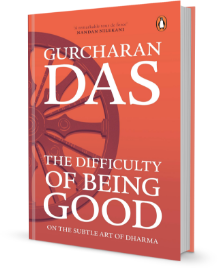
			<content:encoded><![CDATA[<p style="text-align: justify;">I shall be coming to America this fall. What brings me over is a twelve city book tour by Oxford University Press, who are publishing my new book, <a href="/?page_id=237" target="_blank">The Difficulty of Being Good: On the subtle art of dharma</a>. I would genuinely like to meet my former collegues (as I have missed most of the reunions). I shall be visiting from September 20 to October 30. Here are the cities, I shall be visiting:</p>
<p><span id="more-462"></span></p>
<ul>
<li>Sept 20-25 &#8211; Washington DC</li>
<li>Sept 26-Oct 3 &#8211; New York, NJ, CT</li>
<li>Oct 4-6 &#8211; Boston/Cambridge MA</li>
<li>Oct 7-9 &#8211; Philadelphia, PA</li>
<li>Oct 9-11 &#8211; New York, NY</li>
<li>Oct 12-14 &#8211; Chicago, IL</li>
<li>Oct 15-16 &#8211; Seattle, WA</li>
<li>Oct 17-20 &#8211; Bay Area (Santa Cruz, Santa Clara, Berkeley)</li>
<li>Oct 21-24 &#8211; Los Angeles CA</li>
<li>Oct 25-28 &#8211; Austin/Dallas TX</li>
<li>Oct 29-30 &#8211; Atlanta GA</li>
</ul>
<p>Check out <a href="/?page_id=466">detailed schedule here</a>.</p>
]]></content:encoded>
			<wfw:commentRss>http://gurcharandas.org/?feed=rss2&amp;p=462</wfw:commentRss>
		<slash:comments>0</slash:comments>
		</item>
		<item>
		<title>Stranger At Home</title>
		<link>http://gurcharandas.org/?p=457</link>
		<comments>http://gurcharandas.org/?p=457#comments</comments>
		<pubDate>Sun, 15 Aug 2010 07:28:55 +0000</pubDate>
		<dc:creator>Gurcharan Das</dc:creator>
				<category><![CDATA[Magazine]]></category>
		<category><![CDATA[Outlook]]></category>

		<guid isPermaLink="false">http://gurcharandas.org/?p=457</guid>
		<description><![CDATA[English bespeaks progress. India’s youth is much the worse without it. Our obsession with the English language has served us brilliantly. It has kept us united as a nation; it has contributed significantly to the social mobility of Indians; it has been a major factor in our recent success in the global economy.  One of [...]]]></description>
			<content:encoded><![CDATA[<p><strong><em>English bespeaks progress. India’s youth is much the worse without it.</em></strong></p>
<p>Our obsession with the English language has served us brilliantly. It has kept us united as a nation; it has contributed significantly to the social mobility of Indians; it has been a major factor in our recent success in the global economy.</p>
<p> One of the cheerful things happening in India is the quiet democratising of English. Dalits are today its biggest advocates because English allows them to work in call centres and other modern jobs where there are fewer caste barriers. A recent survey in Mumbai shows that Dalit women who knew English rose economically by marrying outside their caste&#8211;31% of Dalit women who knew English had inter-caste marriages compared to 9% who did not know the language. Dalits identify vernacular languages with caste oppression. Hence, Dalits across the country hailed Mayawati’s decision to introduce English from the first grade in U.P. (That there aren’t English teachers is another issue!)<span id="more-457"></span></p>
<p> The linguist, Peggy Mohan, likens social mobility through English to the mobile phone. Just as the masses today are leapfrogging to cell phones without going through a landline stage, Mohan thinks that English will evolve from an elite to a mass, second language of the new emerging Indian middle class. If functioning in pre-literate dialects is not to have a phone; and learning a standard regional language, say <em>shudh</em> Hindi, is to acquire a landline; then aspiring Dalits at English schools, will actually leapfrog from their pre-literate mother tongues to literacy in functional English. The child who confronts English for the first times faces incomprehension initially, but eventually most manage to take a leap into a new world.</p>
<p> U.P. is also a crucible to observe the social mobility of Muslims. Mulayam Singh shares a distaste for the English language and computers with many Muslim clerics. Because he lost Muslim support after his bear hug with Kalyan Singh, he decided to win Muslims back with an anti-English crusade. This strategy backfired, however, for young Muslims find English and computers are the route to good jobs—minority employment in IT/ ITES industry is 12 per cent employment compared to less than 4 per cent in other sectors. It escaped Mulayam’s attention that every mofussil Muslim mohalla and qasba in U.P. has small private English-medium schools catering to artisans, rikshawallas, reriwallas.</p>
<p> Since the nineties there is a new, quiet confidence in our nation, and our attitude to English has also changed. It has become an Indian language. Unlike my generation, today’s young are more relaxed about English and think it a skill, like learning Windows, and comfortably mix it with their mother tongues. When they speak English, even if inaccurately, they feel that they own it. </p>
<p> I do not agree with critics who claim that we have created a rootless elite, which has lost the ability to think because it does speak any language well. I went to an English medium school and work mostly in English but Hindi is my street language. Even though I do not read Hindi newspapers or novels, I have spent the last six years reading the Mahabharata. There are millions of English speaking Indians like me, who balance our language of empowerment (English) with our language of identity (the vernacular). There is thus no danger of losing rich and ancient languages like Marathi and Kannada and vernacular chauvinists are unnecessarily alarmed. That said, if our children had learned both English and vernaculars in a lively way from class one, we would have become a truly bilingual and culturally richer nation.</p>
<p> There is also a problem with the way we teach language. For example, we teach an artificial Hindi in a soulless way, which doesn’t connect with people. Fortunately Bollywood does a much better job and Hindi’s popularity continues to grow. Unless we drastically reform how we teach regional languages, they will suffer the landline’s fate.</p>
<p> English, too, continues to be taught abysmally and we have run out of English teachers. Over the next ten years 3.5 million jobs will be outsourced globally. India is likely to lose these jobs, according to the expert, David Graddol, author of <em>English Next</em>, because we are losing our “English advantage” to other countries. China is doing a far better job in training English teachers, and soon English speakers in China will outnumber those in India, according to Graddol. If this is not a wake-up call, I don’t know what is!<br />
<em>&#8212;-</em></p>
<p><em>Gurcharan Das is the author of </em>India Unbound<em> and </em>The Difficulty of Being Good<em></em></p>
]]></content:encoded>
			<wfw:commentRss>http://gurcharandas.org/?feed=rss2&amp;p=457</wfw:commentRss>
		<slash:comments>0</slash:comments>
		</item>
		<item>
		<title>Dharma in the public place</title>
		<link>http://gurcharandas.org/?p=459</link>
		<comments>http://gurcharandas.org/?p=459#comments</comments>
		<pubDate>Sat, 07 Aug 2010 07:32:15 +0000</pubDate>
		<dc:creator>Gurcharan Das</dc:creator>
				<category><![CDATA[Business Standard]]></category>
		<category><![CDATA[Newspapers]]></category>

		<guid isPermaLink="false">http://gurcharandas.org/?p=459</guid>
		<description><![CDATA[Nothing is quite perfect in the world and certainly not human beings, as the Mahabharata reminds us. Our tendency to latch on to bad news at the expense of good news is unexcelled, and we tend to lose all balance in our judgements and miss out on the small victories of the day. Lalit Modi, [...]]]></description>
			<content:encoded><![CDATA[<p>Nothing is quite perfect in the world and certainly not human beings, as the Mahabharata reminds us. Our tendency to latch on to bad news at the expense of good news is unexcelled, and we tend to lose all balance in our judgements and miss out on the small victories of the day. Lalit Modi, the creator of the Indian Premier League of Cricket (IPL), has gone from being public hero to public enemy and this turnabout causes us some discomfort. If only we realized that dharma in the public place is different from private morality, we might be spared the confusion.    <span id="more-459"></span></p>
<p>The good Vidura tells us in the <em>Mahabharata</em> that in judging a king’s action he looks to results. If it benefits the people, it is an act of dharma. Hence, a ruler would agree to ‘sacrifice an individual for the sake of a village and a village for the sake of a nation’. Vidura is half brother and royal counsellor to the king of Hastinapur and he speaks from the experience of managing a state. In agreeing to sacrifice a person in order to save many, he has drawn a distinction between public and private dharma, a pragmatism that is uniquely suited to public policy. The English thinker, Jeremy Bentham, went on to make this criterion famous in the 19<sup>th</sup> century via his Utilitarian slogan—‘the greatest good of the greatest number’.</p>
<p>Our confusion in judging Lalit Modi arises from our inability to distinguish between public and private acts. Like Yudhishthira in the epic, we get into a muddle because we bring in intentions. Mr Modi’s problem began in March when the IPL decided to expand from eight to ten teams. The winning bids came from the Sahara group for Pune and the Rendezvous consortium for Kochi. The affair came out in the open on 11th April when Mr Modi revealed in a tweet that among the shareholders of the Kochi group was one Sunanda Pushkar from Dubai, who had received Rs 70 crores in ‘sweat equity’ and been seen in public with the minister of state, Shashi Tharoor, who had introduced her as his fiancée. There was public clamour. Who was Ms Pushkar and why did she receive stock options worth Rs 70 crores? And if this was Mr Tharoor’s share, what did he do to deserve it?</p>
<p>Mr Tharoor twittered back accusing Mr Modi of sour grapes because the teams he had backed had lost the auction. Mr Tharoor claimed that he was merely mentor to the Kochi franchise without any financial interest. Ms Pushkar explained that she was an events manager in Dubai who planned to promote the Kochi team and it was common for professionals to get ‘sweat equity’ instead of salary at the start. Neither the opposition nor the government were convinced and Mr Tharoor resigned as minister. In three weeks Lalit Modi was suspended as IPL commissioner.</p>
<p>Sources close to Mr Tharoor allege that after the auction, Mr Modi tried to coerce the Kochi winners to back off—offering them $ 50 million to do so. Since they were adamant, he allegedly appealed to them to shift their franchise to Ahmedabad. Mr Modi counters that 75% of the Kochi capital was from Gujarati businessmen who wanted to stage the matches in a Gujarati city. Besides, the Kochi stadium was incomplete and likely to be embroiled in environmental issues for years.</p>
<p>Other allegations were made against Mr Modi—he was <em>benami</em> shareholder in the Rajasthan team and his relatives had a stake in the Punjab and Kolkota teams; $80 million was paid as ‘facilitation fee’ by Sony/MSM to the World Sports Group to compensate the latter after the contract was renegotiated but the money allegedly went into dubious bank accounts. Lalit Modi’s extravagant life style did not help—a private jet, a yacht, a fleet of Mercedes Benz and BMWs. But Lalit Modi was always a high roller. His father apparently gave him $ 5000 to buy a modest car when he was a student in America, but the young man promptly gave a down payment for a Mercedes Benz. He was also convicted on a drugs abuse. </p>
<p>Mr Modi retorts that he comes from a wealthy family and what has his lifestyle to do with it? Since he does not suffer fools and pettiness, he quickly made enemies with the minions at BCCI who were consumed with envy over his success. But they admit that  IPL would not have been born if the flawed Mr Modi did not possess a rare talent for execution. When faced with adversity in its second year, he shifted IPL’s entire structure to South Africa within weeks, and without a hitch. If he had not snatched autonomy from the small mins of the BCCI, the IPL would have ended as Ranji trophy’s pale copy where they sometimes forget to bring a ball. </p>
<p>The only explanation for Mr Tharoor’s supposed gains is that that businessmen in India still place great faith in the power of politicians to influence outcomes, and in this case 4.5% equity was the price to ensure that their bid won. The losing consortia may also have had their political mentors. It is another reminder of the ever present danger of crony capitalism in a free market democracy.</p>
<p>How do we judge the moral failures of the IPL? Vidura would balance the good against the bad. He would point to the magical nights that it brought to tens of millions of cricket fans on TV; the new cricketing talent it unearthed; the Rs 600 crore that the government earned in service and income taxes; the staggering $4.13 billion in brand value it achieved; and the indefinable value of rare, flawless execution in a nation that is in agony over the Commonwealth Games. Against this Vidura would weigh the negative deeds of Mr Modi and unhesitatingly agree that the law must take its course, and Mr Modi punished for wrongful acts.</p>
<p>But in his personal judgement Vidura would be ambivalent. As he would in judging ambiguous figures like Dhirubhai Ambani, Pratap Singh Kairon, and the Pandava heroes in the epic. Let me illustrate. A few years ago a child almost drowned on a beach in Goa before a young man jumped into the sea and saved it. A few days later the hero confessed to a reporter that he may not have jumped if no one had been watching. He did it, he said, to impress his friends, and particularly one girl in their college party. The reporter said, ‘In that case, you are not such a hero!’ Vidura, however, would have looked to the result and said, ‘But the child was saved! Dharma was done. Why worry about his motives? But Yudhishthira would have jumped in even if no one had been looking. He would have done it as his dharma, as a duty to <em>ahimsa, </em>to save a life.</p>
<p>It is because we confuse intentions and consequences, ends and means, that dharma is <em>sukshma</em>, ‘subtle’, according to Bhishma. In Lalit Modi’s case we bring in his motives—‘he got tempted by greed’; he needed to feed his ego and extravagant lifestyle’ etc. We must remember: ‘The child was saved! What difference does it make if the hero was trying to impress a girl?’<br />
&#8212;</p>
<p><em>Gurcharan Das is the author of ‘The Difficulty of Being Good: On the Subtle Art of Dharma’</em></p>
]]></content:encoded>
			<wfw:commentRss>http://gurcharandas.org/?feed=rss2&amp;p=459</wfw:commentRss>
		<slash:comments>0</slash:comments>
		</item>
		<item>
		<title>Ayn Rand and I</title>
		<link>http://gurcharandas.org/?p=454</link>
		<comments>http://gurcharandas.org/?p=454#comments</comments>
		<pubDate>Tue, 03 Aug 2010 12:40:14 +0000</pubDate>
		<dc:creator>Gurcharan Das</dc:creator>
				<category><![CDATA[Biblio]]></category>
		<category><![CDATA[Magazine]]></category>

		<guid isPermaLink="false">http://gurcharandas.org/?p=454</guid>
		<description><![CDATA[Ayn Rand and the world she made, Anne C. Heller, Tranquebar Press, Chennai, 2010,567 pages, Rs 495, ISBN 978 93 80658 01 8. It is not easy to connect a writer’s life with her ideology.  Most biographers assume that there is an obvious and intimate connection and get on breezily with the job. Too often [...]]]></description>
			<content:encoded><![CDATA[<p><strong><em>Ayn Rand and the world she made, Anne C. Heller, Tranquebar Press, Chennai, 2010,567 pages, Rs 495, ISBN 978 93 80658 01 8.</em></strong></p>
<p>It is not easy to connect a writer’s life with her ideology.  Most biographers assume that there is an obvious and intimate connection and get on breezily with the job. Too often the connection turns out forced and the reader feels that she has been taken for a ride. Anne Heller’s excellent biography of the Ayn Rand is an exception. Her great achievement is to have connected Rand’s extraordinary legend and individualistic philosophy of unbridled capitalism to her life as a youngster, Alissa Zinovievna Rosenbaum, an awkward and wilful Russian Jewish prodigy, who had written four novels by the age of eleven. Heller makes you believe that  that Rand’s excessive self-absorption and vehement protest against any form of collectivism are rooted in her family’s suffering in early-twentieth-century Russia, where Jews were violently persecuted and personal freedom died when the communists came to power.<span id="more-454"></span></p>
<p> ‘Call it fate or irony, but I was born, of all countries on earth, in the one least suitable for a fanatic of individualism, Russia,” wrote Ayn Rand. Her father owned a prosperous pharmacy in St Petersburg and she and her two sisters grew up in an upper middle class home with a cook, a maid, a nurse, and a Belgian governess. Rand made good use of her advantages but disapproved of her mother’s social climbing ways. <script type="text/javascript"></script></p>
<p> It was always dangerous to be a Jew in Russia, however, and as the economy deteriorated during World War I, the Czar grew more repressive and the brunt of popular anger fell upon Russia’s five million Jews. Anti-Semitic bloodshed rose. Czarist gangs groups roamed the countryside, spreading rumours that Jewish profiteering was responsible for war losses and shortages. As the Russian army retreated from the advancing Germans, Russian troops were ordered to round up residents of Jewish villages in the Pale and herd them east to Siberia.</p>
<p> The war created unimagined hardships for all Russians, but especially Russian Jews and its toll in lives and penury led to the revolution. Rand’s family were battered and starving. Lenin’s government after the war consciously initiated the red Terror by encouraging acts of proletarian plunder against the city’s bourgeoisie and twelve-year-old Rand was in the family store on the day Bolshevik soldiers arrived, brandishing guns. In an instant her father was out of business and out of work. The anger and helplessness that Rand she remembered seeing on her father’s face remained with her all her life.</p>
<p> Rand escaped to America at twenty-one by lying to the U.S. consular official that she was engaged to marry a Russian man with whom she was in love and to whom she would unfailingly return. The truth was that she never planned to return to Russia. Ironically, Rand would become famous for celebrating honesty and integrity as indispensable virtues of the capitalist hero. Later she continued to invent, exaggerate, and hide things in order to bolster her public image, and this may be due to her experience as a Russian Jew where small deceptions were a matter of survival. <script type="text/javascript"></script></p>
<p> In America she began life as a middling script writer in Hollywood, where she encountered the same envy, conformity, and mediocrity that she had loathed in Russians. She found the same ‘collectivist motivation’ by which ordinary people sought life’s meaning outside them and looked to someone to tell them what to do. It reinforced the  grand theme of her life: the exceptional individual against the mob. Howard Roark in <em>The Fountainhead </em>became Ayn Rand’s first full-fledged individualist hero: a gifted architect who yearns to create bold new building, but is stopped endlessly by frightened conformists and envious schemers. With this novel, Rand became a cult hero. <em>Atlas Shrugged </em>followed, and together the two books have sold more than 13 million copies, and continue to sell 300,000 per year after three generations.</p>
<p> A good biography makes us look within, and Ms Heller’s book has made me reflect, especially on why I became a libertarian and a vigorous supporter of free enterprise. This book also served as a mirror, making me conscious of the flaws that I share with Ayn Rand, in particular an excessive and unhappy self-regard, and an insatiable desire to be ‘somebody’ and not ‘anybody’.</p>
<p> Like many, I read Rand’s <em>The Fountainhead</em> as a teenager, and could not help but be moved by Howard Roark, who is as American as Huckleberry Finn or Holden Caulfield. He is determined, defies authority, hates mediocrity, and does not seek the world’s praise. He is ‘inner directed’ in an ‘outer-directed’ world, (a distinction I learned from the Harvard sociologist, David Reisman, who had used it to describe the conforming, salaried, American white collar office goer of the 1950s). <script type="text/javascript"></script></p>
<p> I quickly forgot Ayn Rand when I went to college and read serious philosophy. When her name came up in undergraduate conversations, I dismissed her as a writer of potboilers and propaganda. Like everyone around me in the mid-1960s, I passionately believed in Nehru&#8217;s dream of a modern and just India.  But as the years went by, I discovered that Nehru&#8217;s economic path was taking us to a dead-end. Having set out to create socialism, he had created statism. Later when I was working as a manager I found myself caught in the thick jungle of Kafkaesque bureaucratic controls, a story that I have told in <em>India</em><em> Unbound.</em></p>
<p> Thus, I came to admire free enterprise after decades of living under the inefficiency of Nehru’s ‘mixed economy’ or License Raj, as many call it. Whereas I turned against state control from economic compulsions, Rand came to free enterprise from her collectivist Russian experience. I rebelled against the inefficiency of socialism; she revolted against its lack of human freedom and individuality. My embrace of markets was a pragmatic decision; she sought in capitalism a moral foundation. Both of us ended in a suspicion of state power but our paths were different. For me political liberty was not an issue because India had uniquely embraced democracy before capitalism. Democracy came to India soon after 1947 but our love affair with capitalism only began seriously after the 1991 Reforms when we began to dismantle the socialist institutions of the License Raj. <script type="text/javascript"></script></p>
<p> Ayn Rand understood that free markets brought phenomenal productivity and prosperity, but to her it was a side effect. The real deal was that capitalism gave a person’s ‘natural, healthy egoism’ the freedom to enrich himself and others. ‘Selfishness is a magnificent force’, she declared. ‘I decided to become a writer – not in order to save the world, nor to serve my fellow men—but out of the simple, personal, selfish, egoistical happiness of creating the kind of men and events I could like, respect, and admire’, she wrote in 1945.</p>
<p> I must confess that I was not able to go as far as Ayn Rand in embracing individualism as a creed; nor did I become a votary of unbridled, laissez faire capitalism. I also think that her use of the word ‘selfishness’ was unfortunate (perhaps, because she learned English late in life after coming to America). She would have been more effective if she had distinguished between ‘self-interest’ and ‘selfishness’. One would not wake up in the morning if one is not self-interested; but selfishness in ordinary English usage suggests the pursuit of one’s ambition at the expense of others. I suspect she meant the former sense of ‘self-interest’, which is a natural, rational instinct and which leads to healthy ambition without trampling on others (implied in more negative ‘selfishness’).</p>
<p> Unlike Rand, I set great store by enlightened regulation in the free market—regulation that brings transparency in transactions, ensures competition, catches crooks, but does not kill the animal spirits of entrepreneurs (as we did during the License Raj). Like ancient Greeks, Ayn Rand looked to human reason to distinguish the moral from the immoral to guide and protect human beings in this uncertain world. I look to the ancient Indian idea of dharma. My thinking on capitalism has been tempered by my encounter with the epic, The <em>Mahabharata</em>, which I read between 2004 and 2008.</p>
<p> Capitalism is still trying to find a comfortable home in India and I believe players in the marketplace have a great responsibility to act with restraint, unlike Wall Street bankers in the recent global financial crisis. ‘Restraint’ is one of the meanings of dharma; so as is ‘balance’; both meanings of dharma appear in the Mahabharata. If human beings act with ‘balance’ there is harmony in society and the cosmos. India is still a half-reformed economy&#8211;huge sectors like real estate and infrastructure are still unreformed&#8211;and we need to keep reforming it, reducing the discretionary power of officials and politicians.</p>
<p> Successes of capitalism produce over time enervating influences when a generation committed to saving is replaced by one devoted to spending. Ferocious competition is a feature of the free market and it can be corrosive. But c <script type="text/javascript"></script>ompetition is also an economic stimulant that promotes human welfare. The choice is not between the free market and central planning but in getting the right mix of regulation. No one wants state ownership of production where the absence of competition corrodes the character even more, as Ayn Rand pointed out repeatedly. The answer is not to seek moral perfection which inevitably leads to theocracy and dictatorship. Since it is in man’s nature to want more, the notion of dharma teaches us to learn to live with human imperfection, and seek regulation that not only tames crooks in the market but also reward good behaviour.</p>
<p> I was particularly distressed by Ayn Rand’s support for Senator McCarthy’s witch-hunt of American communists in the 1950s. Rand felt alienated in New York, ‘which was such a politically liberal city in the 1950s that Saul Bellow descried it as an intellectual annex of Moscow’. Anne Heller adds, ‘the post-war Right tended to view McCarthy’s Senate hearings as not only necessary on their face but also as payback for earlier leftist allegations that the antiwar, pro-capitalist Old right conservatives were Nazis and Fascists. Rand’s support for McCarthy, as for HUAC [the House Un-American Activities Committee], may have had as such to do with her fragile understanding of American due process as with her principled abhorrence of Communism’.</p>
<p> I too abhor Communism but I have never felt the need to punish Communists for their convictions. I also feel alienated in a gathering of Left-leaning intellectuals in India as Rand did in the America of the New Deal. I have always believed that Senator McCarthy was a vicious and undemocratic American. He was driven by an intolerance that was deeply un-American in its temper, and he diminished his country in the eyes of the world. Soon after McCarthy died from alcoholism in the 1950s, Rand innocently asked Joan Kennedy Taylor, ‘Tell me, what did people have against McCarthy?’ <script type="text/javascript"></script></p>
<p> Taylor replied, ‘Well, Ayn, it’s primarily because he wasn’t truthful. He said all these things and couldn’t back them up.’ And Rand said, ‘Oh, I see. The Big Lie’.</p>
<p> Rand liked McCarthy and detested Eisenhower, ‘a conservative who lacked principles and backbone’. She was indignant over a 1957 <em>Time </em>Magazine article recounting a 1945 meeting between General Eisenhower and his Russian counterpart, Marshal Georgy Zhukov, in Berlin. The two had been debating the strengths of their respective forms of government. The article quoted Eisenhower as saying, ‘I was hard put to it when [Zhukov] insisted that [the Soviet] system appealed to the idealistic and [that ours appealed] completely to the materialistic, and I had a very tough time trying to defend our position because he said: “You tell a person he can do as he pleases, he can act as he pleases, he can do anything. Everything that is selfish in man you appeal to…. We tell him that he must sacrifice for the state.” The fact that Eisenhower couldn’t defend ‘the noblest, freest country in the history of the world’ as a matter of principle against a puppet of ‘the bloodiest dictatorship in history’ infuriated Rand.</p>
<p> I agree with Rand’s conclusion. Without a morality of rational self-interest capitalism cannot be defended. The problem of capitalism is the inability and the lack of courage of its defenders to defend it. It is difficult to defend the capitalist idea of the ‘invisible hand’ (made famous by Adam Smith) because the hand is, in fact, ‘invisible’. In contrast, equality and sacrifice for the masses are visible ideals. <script type="text/javascript"></script></p>
<p> As a libertarian, I have always admired the Austrian economist Ludwig von Mises. I agree with him that political liberty is founded on private property, free markets, and limited government. A Jewish refugee from Nazi occupied Austria, he had been a great social and economic theorist in pre-war Europe but was unknown in America. Mises met Ayn Rand in the early 1950s in New York and they quarrelled immediately over the government’s right to impose conscription or forced military service or ‘draft’, which was then underway in America. Mises, who had a purely economic aversion to state power, supported it. Rand called it a violation of individual rights. Rand became angry and said, ‘you treat me like an ignorant Jewish girl!’ Henry Hazlitt, their host, tried to make peace, ‘Oh, I’m sure, Ayn, that Lu didn’t mean it that way’. Mises jumped to his feet and shouted, ‘I did mean it that way!’</p>
<p> The following day she met one of the guests who had been present at the dinner party, and asked him to take sides in the dispute. When he pleaded neutrality, she replied, ‘That’s not possible. You are either with him or against me.’ He refused to choose and she never spoke to him again. In her copy of Mises’ famous book,<em> Human Action</em>, Rand wrote ‘bastard’ in the margin because Mises preferred a practical, economic argument for capitalism rather than a moral one.  </p>
<p><script type="text/javascript"></script> Rand emerges somewhat diminished from Heller’s vivid and affecting account of this great champion of liberty and individuality who insisted on obedience and conformity from her followers (including from Alan Greenspan). A friend of John Hospers tried to console him after their falling-out: ‘Well John,’ the friend said, ‘You were a scholar. She was a revolutionary’.</p>
]]></content:encoded>
			<wfw:commentRss>http://gurcharandas.org/?feed=rss2&amp;p=454</wfw:commentRss>
		<slash:comments>0</slash:comments>
		</item>
		<item>
		<title>On moral luck and human vulnerability</title>
		<link>http://gurcharandas.org/?p=451</link>
		<comments>http://gurcharandas.org/?p=451#comments</comments>
		<pubDate>Sat, 03 Jul 2010 08:33:05 +0000</pubDate>
		<dc:creator>Gurcharan Das</dc:creator>
				<category><![CDATA[Business Standard]]></category>
		<category><![CDATA[Newspapers]]></category>

		<guid isPermaLink="false">http://gurcharandas.org/?p=451</guid>
		<description><![CDATA[I was in Mumbai on that December night in 1984 when tragedy struck in Bhopal. I was head of an American multinational’s Indian subsidiary, a company not unlike Union Carbide, whose managing director also happened to be my friend. We were among a few foreign companies that had stayed on and had toughened under the [...]]]></description>
			<content:encoded><![CDATA[<p>I was in Mumbai on that December night in 1984 when tragedy struck in Bhopal. I was head of an American multinational’s Indian subsidiary, a company not unlike Union Carbide, whose managing director also happened to be my friend. We were among a few foreign companies that had stayed on and had toughened under the punishing conditions of the ‘license-quota-permit raj’. I was in shock over the horrific human tragedy but my sadness came from another thought, ‘what if it had been me’? I placed myself in his shoes and wondered if I would have acted differently?  Probably not, and I thought about human vulnerability and how unbelievable lucky I was.<span id="more-451"></span></p>
<p> The epic, <em>Mahabharata</em>, reminds us that life is uncertain. Just as Yudhishthira is consecrated ‘universal sovereign’, he gets trapped in a rigged game of dice and loses everything, including his kingdom and his wife. The loaded dice is a metaphor for the fragile human condition. Imagine, if life is a game of dice governed by rules known to be deceptive, in which the least competent player is forced to stake everything, knowing full well that he will lose? Imagine too that death is the only outcome of the game. ‘In such a world one mostly fights for time,’ says David Shulman, the great Sanskrit scholar.</p>
<p> Clouds of poisonous gas rose in the night sky of December 3 from the Union Carbide factory, killing some 2,250 people and affecting 578,000 others. Of that number, it is estimated that between 15,000 and 25,000 people died subsequently, and tens of thousands of others remain sick to this day. No one in India seemed to know how to cope with the greatest disaster in industrial history and I could feel frustration rising in the nation as the days rolled on.  Our national frustration then was not unlike America’s growing aggravation today as each new drop of BP oil that leaks into the Gulf of Mexico.</p>
<p> Twenty five years later, a court has awarded a two year sentence of rigorous imprisonment to seven persons, including my friend, in the Bhopal case. There has been national outrage both at the delay and the lightness of the sentence. Indignation at the sentence is understandable for so horrific a disaster&#8211;the human psyche seeks equally gruesome punishment to maintain moral equilibrium. The dawdling pace of justice in India is, of course, a national disgrace which diminishes us daily, but the fact is that crime and punishment in an industrial disaster is a difficult and complex issue.</p>
<p> In order to establish a higher level of crime would require showing criminal intent or prior knowledge of the disaster. For a higher sentence, the prosecutor would have to link the leaking of gas by an unbreakable chain of events to failure of individuals. It is difficult to imagine that directors or employees could have known that negligence on their part would lead to catastrophe of such proportions, and if they had known of the consequences, would they have ignored it? In the absence of intent, the only crime is of ‘rashness and negligence’ and for which the managers have been punished. But I am not sure if even that sentence will be sustained in appeal. The managers at Union Carbide knew they were dealing with a hazardous chemical but had no inkling that either the plant design or their operation was flawed. The 1982 audit report had pointed out few infirmities but they had reportedly rectified them.  </p>
<p> The ‘evidentiary link’ was also missing in Andersen’s case, and this explains why India has failed to extradite him. The same logic applies to criminality in the recent, disastrous oil spill in the Gulf of Mexico. Nevertheless, Carbide got away by paying a paltry penalty for the worst industrial disaster in history. It is especially galling when you compare with what BP has paid and will end up paying.  The tiny payment has fanned anti-multinational sentiment in India and reinforced a belief that multinationals have double standards. The truth is that multinational operations throughout the developing world are run to much higher technical and managerial standards than local companies.  Look, for example, at the safety standards of the Indian railways. When did we last try to jail a railways minister or employee for negligence?</p>
<p> I compliment the Group of Ministers for their balanced and determined approach in recent weeks. It has restored sanity in our society whose discourse had been overtaken by a lynch-mob mentality. They have rightly recognized that the first and foremost duty is to the victims of the disaster and their survivors. Dow Chemicals, although it has no legal responsibility, should share in the financial burden as an act of magnanimity.  If only the government had shown this sanity and determination twenty-five years ago so much suffering and tragedy could have been averted.</p>
<p>The lesson from Bhopal and from BP’s oil spill is that we need tort remedies to address the risk of future disasters.  The legal system should not allow private individuals to keep the gains from dangerous activity and pass off losses to the public. We require liability to be fixed in advance on companies. Once these remedies are in place we can relax our ever-present licence-permit mentality. Solid insurance underwriting is likely to do a better job in pricing risk than any program of direct government oversight. This logic also suggests that America needs to rethink the Price Anderson Act&#8217;s $375 million cap on damages to cover nuclear power disasters.</p>
<p>All this has reinforced my belief in the ancient Greek idea of moral luck. It could have been <em>me</em> sleeping innocently on December 3rd under the poisonous cloud. It could have been <em>me </em>working for Union Carbide? The Greeks knew that human life is fragile, but their lyric poet, Pindar, felt that its peculiar beauty also lay in human fragility. He compares a human being to a fragile vine ever in need of fostering weather. It needs gentle dew and rain and the absence of sudden frosts&#8211;and it needs caring keepers. So do human beings need fostering, but we also need to keep clear of catastrophe. Greek philosophers hoped to banish contingency by living a life of reason. Ancient Indians, on the other hand, believed that righteous action according to dharma would reduce their vulnerability.</p>
<p>India is becoming a venturesome, entrepreneurial society like America. Humans have a tendency to procrastinate. We don’t take advance measures because disaster is distant and unlikely.  Prevention is costly and tedious, and frankly there is so much to do in the here and now.  Since the consequences could be ominous, the low risk of occurring should not be a reason to ignore it.  So, we need regulation. Regulation should be strong enough to reduce risk, yet not so strong as to stifle our new found entrepreneurial energy. We want regulators to work cooperatively with companies but not to be captured by them&#8211;‘crony capitalism’ is an ever present danger in our young capitalist democracy. In the end, no amount of regulation will prevent catastrophe. Humans are prone to err. What is needed is dharma or good faith among both companies and officials to limit harm. Regulators should also remember that costs forced on companies become higher costs for consumers.</p>
<p><em>Gurcharan Das is the author of ‘The Difficulty of Being Good: On the Subtle Art of Dharma’</em></p>
]]></content:encoded>
			<wfw:commentRss>http://gurcharandas.org/?feed=rss2&amp;p=451</wfw:commentRss>
		<slash:comments>0</slash:comments>
		</item>
		<item>
		<title>Private Affluence, Public Squalor</title>
		<link>http://gurcharandas.org/?p=447</link>
		<comments>http://gurcharandas.org/?p=447#comments</comments>
		<pubDate>Sat, 05 Jun 2010 11:23:31 +0000</pubDate>
		<dc:creator>Gurcharan Das</dc:creator>
				<category><![CDATA[Business Standard]]></category>
		<category><![CDATA[Newspapers]]></category>

		<guid isPermaLink="false">http://gurcharandas.org/?p=447</guid>
		<description><![CDATA[ Recently on Karan Thapar’s program on television, a ‘stylish left wing’ commentator (SLW for short, a useful acronym that I owe to Saubhik Chakrabarti) said with a straight face that our troubles with the Maoists originated in our neo-liberal economic model and our post-1991obsession with growth. She then went on to lecture us about the [...]]]></description>
			<content:encoded><![CDATA[<p> Recently on Karan Thapar’s program on television, a ‘stylish left wing’ commentator (SLW for short, a useful acronym that I owe to Saubhik Chakrabarti) said with a straight face that our troubles with the Maoists originated in our neo-liberal economic model and our post-1991obsession with growth. She then went on to lecture us about the callousness of the new middle class whose chief passion is vulgar consumption, and there is growing disparity between the rich and the poor. <span id="more-447"></span></p>
<p> Karan Thapar, sensing a juicy moment of controversy, smacked his lips and looked intently at me, asking me to respond. I explained patiently to my distinguished SLW panellist that growth is a necessary condition for lifting the poor everywhere, including in the tribal areas. It is not a sufficient condition, however, for people also need functioning schools and primary health centres, honest policemen and forest officers. The real problem, I said, is not with our economic model, but with poor governance. As a result we have public squalor amidst private affluence. So, don’t blame growth, blame the state’s inability to deliver public services, especially in remote tribal areas, where the police and forest officers tend to be rapacious.</p>
<p> Private success and public failure is an old debate between the defenders of capitalism and its critics, but it has revived again after the global financial crisis of 2008. Hence the historian, Tony Judt, laments like my SLW panellist, in his new book, <em>Ill Fares the Land</em>: ‘Something is profoundly wrong with the way we live today. For thirty years we have made a virtue of the pursuit of material self-interest indeed, this very pursuit now constitutes whatever remains of collective purpose.”</p>
<p> For a hundred years, public life in liberal Western societies has been conducted in the shadow of the Left-Right divide and it has provided a peg to understand public affairs. In the 1960s, politics infected the young who thought they knew how to fix the world. In the 1970s, there was a backlash to their unmerited arrogance. The Right triumphed intellectually in the 1970s and politically in the 1980s with success of Thatcher and Reagan. The Left grew defensive, especially after the collapse of communism. By 2000, the Washington consensus was the ruling wisdom in the world as country after country deregulated, lowered taxes and privatised enthusiastically. Today, after the crash of 2008, there is an awakening, and the Leftish rhetoric of Obama in America resonates with voters.</p>
<p> We have a somewhat different Left-Right divide in India. Most of us who call ourselves liberals in India are tolerant of dissenting attitudes and oppose interference in the affairs of others, but we do not generally oppose state intervention on ideological grounds. We do have a deep commitment to religious and political tolerance, but most of us would be called ‘social democrats’ in Europe.  Although we do not generally oppose state intervention on behalf of the poor, we do feel badly let down by the incapacity, incompetence, and corruption of the Indian state. The inefficiency of the public sector is an issue everywhere, but in India it diminishes us daily.  We do not oppose the public sector for threatening our liberty, as Americans do. We oppose it for its inefficiency. Our problem is not of the ‘what’ but of the ‘how’. </p>
<p>Meanwhile, the world has also changed. Despite the crash of 2008, hardly anyone really wants to replace capitalism. People mostly want to reform the financial sector. It was different when I was in college. We believed that a state-run economy was the best way to promote growth. Today nobody does, except perhaps in North Korea. Policy makers everywhere, especially those under the age of fifty, have a free-market orientation. There may be differences of emphasis, but they are all oriented toward markets. One reason is that capitalism has produced the highest standard of living in history. Since 1991, it has lifted millions of people in China, India, and Brazil out of poverty.  </p>
<p>Ideology thus seems to have had its day. Marxism is no longer attractive to the young. No one defends the public sector on the grounds of collective interest. There are, of course, many models capitalism in the world. The countries of Scandinavia are more egalitarian; those on the European continent have a much greater commitment to public health and welfare; the English speaking countries, especially the UK and America, have the greatest commitment to the market and are the most suspicious of excessive regulation. They also suffer from the greatest inequality.</p>
<p> The future of India and China is mercifully no longer dependent on ideology. The race between the two hangs on the more practical question if India can fix its governance before China fixes its politics. Because the state has failed to deliver in India our policy makers increasingly seek pragmatic public-private partnerships. But this is a slow process for people are still suspicious of the market. They may not seek moral perfection in public life but they tend to impute good motives to government officials. They think businessmen make money for their own good and markets loot the unfortunate. They have trouble in seeing that the pursuit of profits can lift the general standard of living of the whole population. The idea is too counterintuitive. Hence, SLW commentators are always popular on TV.</p>
<p> Like Max Weber, the <em>Mahabharata,</em> would have approved of ideology’s decline in our times. The epic is unique in engaging with the world of politics and suspicious of public figures who seek moral perfection. When King Yudhishthira feels guilty after the war for ‘having killed those who ought not to be killed’, he decides to renounce the throne. To avert a political crisis, the dying Bhishma tries to dissuade him, teaching him that the dharma of a political leader is pragmatic and prudent, what Edmund Burke called the ‘god of this lower world.’ A political leader must eschew the ‘ethic of ultimate ends’ and follow the ‘ethic of responsibility’, as Weber put it. Our experience with the last UPA government taught us that when ideology becomes the driving force of politics then room for compromise is diminished and this makes for a dangerous world. The answer to Maoism in our tribal areas is to reform public institutions—the police, bureaucracy, and the judiciary&#8211;and not get distracted by futile, SLV discussions of economic models. <strong></strong></p>
<p> &#8212;&#8211;</p>
<p> <em>Gurcharan Das is the author of ‘The Difficulty of Being Good: On the Subtle Art of Dharma’</em></p>
]]></content:encoded>
			<wfw:commentRss>http://gurcharandas.org/?feed=rss2&amp;p=447</wfw:commentRss>
		<slash:comments>0</slash:comments>
		</item>
		<item>
		<title>IPL and Capitalism</title>
		<link>http://gurcharandas.org/?p=444</link>
		<comments>http://gurcharandas.org/?p=444#comments</comments>
		<pubDate>Sat, 01 May 2010 11:13:23 +0000</pubDate>
		<dc:creator>Gurcharan Das</dc:creator>
				<category><![CDATA[Business Standard]]></category>
		<category><![CDATA[Newspapers]]></category>

		<guid isPermaLink="false">http://gurcharandas.org/?p=444</guid>
		<description><![CDATA[ The recently concluded Indian Premier League (IPL) has been a non-stop party that lasted for six weeks to which everyone was invited provided you wanted to have fun. It brought magical nights to millions across India, a respite from their drab, desperate lives. It was filled to the brim with desire&#8211;for cricket and Bollywood, for [...]]]></description>
			<content:encoded><![CDATA[<p> The recently concluded Indian Premier League (IPL) has been a non-stop party that lasted for six weeks to which everyone was invited provided you wanted to have fun. It brought magical nights to millions across India, a respite from their drab, desperate lives. It was filled to the brim with desire&#8211;for cricket and Bollywood, for chatter and glamour, for tomfoolery and unrequited sensuality, and for high rolling betting. (There was even satta market on the beleaguered Lalit Modi’s fate as the league commissioner, and the returns from every rupee on Mr Modi surviving were Rs 5.50 last Saturday.)<span id="more-444"></span></p>
<p> IPL is indeed a metaphor for a new India—crass, brash and razzmatazz&#8211;but it is in big trouble. What began as a trifling spat between Shashi Tharoor and Lalit Modi ended in the resignation of the minister and the suspension of the IPL commissioner. Everyone has had a say by now and some good suggestions have emerged for the reform of the IPL and the cricket board (BCCI). But in the chorus of remonstration there was a definite anti-capitalist refrain. Coming as this does on the heels of the global financial crisis and the recent troubles of Goldman Sachs, the legitimacy of the market is once again in question in a country where capitalism is still trying to find a comfortable home.</p>
<p> The most strident voices belonged to members of Parliament who demanded a probe by a Joint Parliamentary Committee. Some political parties called for nationalizing the IPL. Lalu Prasad (RJD), Mulayam Singh Yadav (SP) and Sharad Yadav (JD-U) insisted on banning it. The JD(U) member, Shivanand Tiwari, demanded that funds of the IPL and BCCI be confiscated. CPI leader Gurudas Dasgupta criticised the 20-20 game format, saying it was a ‘caricature’ of cricket in which players were bought like ‘vegetables’. The deputy leader of the Opposition, Gopinath Munde asked that if bar girls in Mumbai had been barred from performing, why should cheerleading girls be allowed in the IPL? Mulayam Singh called cricket a ‘foreign game’ and wanted it replaced by a desi one.</p>
<p> How does one begin to judge the IPL?  When it comes to public policy, it is best to follow the advice of Vidura, the royal adviser in the <em>Mahabharata</em>, who looks to the general good. If an act benefits the vast majority then it is right. Cricket’s two main stakeholders are the players and the fans. It has given an opportunity to many talented cricketers to rise and showcase their talents. Going by television ratings and packed stadiums, more Indians have been entertained by the IPL than anything else. By Vidura’s criterion, IPL has performed brilliantly. Lalit Modi is undoubtedly a great entrepreneur who has also driven the IPL’s brand value to a staggering $4.13 billion in less than three years.   </p>
<p> There are serious problems, however. Conclusive proof must be found for match-fixing, rigged auctions, tampering with roster selections and other allegations. We need full public disclosure of all the bids. Modi must be tried fairly based on evidence, not personal dislike. BCCI must also be overhauled. As the custodian of cricket, it runs like a cabal, exploiting its monopoly privileges. As to gambling, the best answer is to make sports betting legal—then it will open and fair. This will generate huge revenues for the government and cut the nexus with the underworld.</p>
<p>With regard to the competitive status of Indian cricket, our team has become world’s no. 1 in tests; it is clawing to the top in the one day version; and the 20/20 team did win the inaugural world cup. BCCI’s seems to have delivered far better performance than other sports associations, where government plays a bigger role.</p>
<p>A Rajya Sabha member complained that the evil in IPL was foreign and he traced it to the market. The honourable member did not realise that markets are natural to human beings. Banias and bazaars have been with us for thousand of years, ever since Indians first engaged in agriculture and there was a surplus. Our first towns in the Indus valley emerged as centres of exchange. But markets are not the same thing as the market system, which requires that moneymaking be regarded as respectable. Historically, commerce has had a bad odour in all societies. In India, the merchant was third in the cast hierarchy. Even though we have the wondrous spectacle of thousands of young Indians starting business ventures today, the idea that their struggle for personal gain might actually promote the common is too bizarre. This is behind the animus against the big sums in the IPL. Even sophisticated Indians distrust the market – perhaps, because no one is in charge. No wonder Samuel Johnson said, “There is nothing which requires more to be illustrated by philosophy than trade does.”</p>
<p>Besides politicians, journalists and academics have been the most vociferous in criticising IPL’s capitalist ideology. The philosopher, Robert Nozick explains in a classic essay why intellectuals everywhere dislike capitalism.  They feel entitled to greater prestige, money and power, whereas the market rewards those who fulfil perceived demand in the marketplace. The wordsmith’s expectation is created early in school. In the classroom the brightest are rewarded with the highest marks and teachers’ smiles. Hence, they grow up expecting praise. When it does not come in later life, and when society values things other than verbal ability, they grow resentful and sullen, especially when they experience downward mobility.   </p>
<p>Lalit Modi’s entrepreneurship necessarily involved assuming risks and valuing novelty, characteristics that are not common in a stable society. He was a brash new kid around the block, and he will admit that entrepreneurial success does not lead to social acceptance. Old money does not like new money. The economic historian, Jean Baechler, tells us that in sixth century BC firms in Babylon took in money deposits, issued cheques, made loans at interest, and invested in agricultural and industrial enterprises. Yet they were looked down upon. All agrarian civilizations have looked down upon merchant capitalists and commercial activities have been universally held in low esteem.</p>
<p>It was only in the High Middle Ages that this changed, and capitalists were finally given social acceptance and protection from the predation of the state, as Deepak Lal argues in <em>Unintended Consequences.</em> It was due to a legal revolution in the eleventh century when Pope Gregory VII in 1075 put the church above the state. The resulting church-state created the whole legal and administrative infrastructure required by a full fledged market economy. This led to the rise of the West and its divergence from the rest of the world.</p>
<p>India after 1991 has joined in this capitalist adventure, and with vigour. Because India got democracy before capitalism, the critique of capitalism began in the 1950s even before full blown capitalism arrived in 1990s. Hence, players in the capitalist game have a responsibility to behave with restraint until capitalism establishes a comfortable home. IPL’s irregularities have not helped. But having said that, it is impressive that the critique of IPL has been constructive by and large, and shows we have come a long way in our attitudes. The challenge before regulators remains—how to bring transparency in the market without killing the animal spirits of the likes of Lalit Modi.</p>
<p><em>Gurcharan Das is the author of ‘The Difficulty of Being Good: On the Subtle Art of Dharma’</em></p>
]]></content:encoded>
			<wfw:commentRss>http://gurcharandas.org/?feed=rss2&amp;p=444</wfw:commentRss>
		<slash:comments>0</slash:comments>
		</item>
		<item>
		<title>Don’t close down budget schools, give them graded recognition</title>
		<link>http://gurcharandas.org/?p=442</link>
		<comments>http://gurcharandas.org/?p=442#comments</comments>
		<pubDate>Sat, 03 Apr 2010 10:38:41 +0000</pubDate>
		<dc:creator>Gurcharan Das</dc:creator>
				<category><![CDATA[Business Standard]]></category>
		<category><![CDATA[Newspapers]]></category>

		<guid isPermaLink="false">http://gurcharandas.org/?p=442</guid>
		<description><![CDATA[Unrecognised private schools, which cater to the poor in the slums and villages of India, have been under threat for a long time. With the passage of the Right to Education Act the threat is now real. The new law specifically calls for these schools to be closed or recognized within three years. In 2008, [...]]]></description>
			<content:encoded><![CDATA[<p>Unrecognised private schools, which cater to the poor in the slums and villages of India, have been under threat for a long time. With the passage of the Right to Education Act the threat is now real. The new law specifically calls for these schools to be closed or recognized within three years. In 2008, the Delhi High Court in 2008 had also wanted to close roughly 10,000 such schools in the national capital.<span id="more-442"></span></p>
<p> The reason why budget schools do not get recognition is because they do not meet standards—for example, they do not have a playing field of a certain size or they cannot pay the minimum government teacher’s salary&#8211;which is over Rs 20,000 a month after the Sixth Pay Commission. If they had to pay this salary or have such a playing field, they would have to quadruple their fee and the poor would no longer be able to afford it.</p>
<p> Unrecognised private schools are successful because teachers are accountable to parents who can move their child to a competing school if they are not satisfied. In a government school there is little accountability as teachers have permanent jobs with salaries and promotions unrelated to performance. Hence, one in four government primary teachers is absent and one in four who is present but found not to be teaching. This horrendous situation is obvious to the poorest parent.</p>
<p> No one knows how many unrecognized schools exist in India but estimates range in the lakhs. To want to close down institutions that serve communities and meet a gap in the supply of education seems bizarre and even immoral. The government’s answer is that these schools are of poor quality. This means that it thinks that millions of parents who send children to these inferior schools must be stupid. Why would parents pay hard earned income when a child could be educated free and get a free mid-day meal in a government school? The government’s answer is that parents are duped by ‘unscrupulous elements’. It is the command mindset—‘I know what is good for you!’ You can fool some people some of the time, they say, but not all the people all the time. Lakhs of private schools cannot enrol millions of children for decades unless they meet a genuine need. The irony is that while sending its own children to private schools, the establishment stridently opposes a similar choice for the poor.</p>
<p> Why is it that we do not trust private initiative in education? Even eminent persons like Amartya Sen, who believe in the efficiency of the market, draw a line when comes to delivering education privately. Our animus against the market may have diminished considerably after liberalization in 1991 and the fall of communism, but most Indians still suspect capitalism. People increasingly believe that markets deliver prosperity but they do not think that capitalism is moral. Even those who work inside the system feel guilty and do not value what they do.<strong> </strong></p>
<p><strong> </strong>Greater reflection will show that human self-interest goes a long way in ensuring good behaviour in a competitive marketplace. A seller who does not treat his customers with fairness and civility will lose market share. A company that markets a defective product will quickly lose its reputation and its customers. False claims will lower sales. A firm that does not promote the most deserving employees will lose talent to its competitors. A purchase manager who does not buy at the right price will soon make his company uncompetitive and it will not survive. Lying and cheating will ruin a firm’s image, making it untouchable to creditors and suppliers. Hence, the free market does offer powerful incentives for ethical conduct backed, of course, by state institutions that enforce contracts and punish criminal behaviour.</p>
<p> I used to believe that government schools were the only answer for universal education. Then I read interviews with parents in slums about why they had removed their children from government schools with better facilities. The answer in most cases was that teachers did not show up, and when they did, they were not interested in teaching. Parents felt helpless and could do nothing because teachers only felt responsible to superiors in the state capital. Moreover, parents wanted children to learn English and computers, but teachers were either indifferent or incompetent to meet this demand. Budget private schools may do bad job of teaching English, but at least they try. Teachers are more motivated, and there is the ever present threat of losing the child to a competitive school. Now I understand why more than half the children in India’s cities and a quarter in India’s villages are in private schools.</p>
<p> Government makes it difficult for private schools to function. I was baffled to learn how often inspectors visit unrecognized private schools. It is not because of an unusual dedication to standards but to be ‘made happy’, as one private school owner put it. Schools have to bribe to keep inspectors from closing them down. Hence, they believe that the main impact that the Right to Education Act will be to raise the bribe required to keep inspectors ‘happy’. This in turn will force schools to raise school fees, and the burden will fall on the poor.</p>
<p>  The answer is not to close down budget schools but to understand their situation. Since they cater to the poor, there could be a graded system of recognition. If we can have a first and a second class in the train why not officially designate ‘first’ and ‘second’ categories for schools. Since real estate is expensive, don’t insist on a size of a football field but allow budget school to operate with a smaller play area. Don’t insist on government salaries for teachers but give them autonomy to pay what the market allows. Set up rating agencies to assess the quality of both government and private schools to help parents to exercise choice. Of course, our first priority must be to reform government schools and that happens who will want to send her child to a private school anyway?</p>
<p> Finally, don’t be contemptuous. Don’t refer to them as ‘mushrooming schools run by unscrupulous elements’. Look at them instead as a heroic example of people solving their own problems. School entrepreneurs are like micro-finance companies who are trying to compete and ‘make a fortune at the bottom of the pyramid’. What they need is a safe environment free from rapacious inspectors. They need titles to their property so that they can use it as collateral to raise expansion capital. Like microfinance, which has come of age, budget schools will one day build scale and brand names. They are symbolic of India’s unique economic model—of a nation rising despite the state.  </p>
<p> <em>Gurcharan Das is the author of The Difficulty of Being Good: on the subtle art of dharma (Penguin 2009)</em></p>
]]></content:encoded>
			<wfw:commentRss>http://gurcharandas.org/?feed=rss2&amp;p=442</wfw:commentRss>
		<slash:comments>3</slash:comments>
		</item>
		<item>
		<title>Entrepreneurs and Eggplant</title>
		<link>http://gurcharandas.org/?p=431</link>
		<comments>http://gurcharandas.org/?p=431#comments</comments>
		<pubDate>Mon, 08 Mar 2010 09:57:21 +0000</pubDate>
		<dc:creator>Gurcharan Das</dc:creator>
				<category><![CDATA[Newspapers]]></category>
		<category><![CDATA[Wall Street Journal]]></category>

		<guid isPermaLink="false">http://gurcharandas.org/?p=431</guid>
		<description><![CDATA[  THE WALL STREET JOURNAL OPINION ASI A MARCH 8, 2010, 2:06 P.M. ET Entrepreneurs and Eggplant A case study in how India&#8217;s government is the main obstacle to economic progress. By GURCHARAN DAS New Delhi Risk is built into capitalism because the rewards of investment arrive in the future. Risk usually comes from the unknown responses [...]]]></description>
			<content:encoded><![CDATA[<p> <strong> <span style="text-decoration: underline;">THE WALL STREET JOURNAL</span></strong></p>
<p><a href="http://online.wsj.com/public/search?article-doc-type=%7BOpinion+Asia%7D&amp;HEADER_TEXT=opinion+asia">OPINION ASI A</a><br />
MARCH 8, 2010, 2:06 P.M. ET</p>
<h1>Entrepreneurs and Eggplant</h1>
<h2><em>A case study in how India&#8217;s government is the main obstacle to economic progress.</em></h2>
<h3>By <a href="http://online.wsj.com/search/search_center.html?KEYWORDS=GURCHARAN+DAS&amp;ARTICLESEARCHQUERY_PARSER=bylineAND">GURCHARAN DAS</a></h3>
<p><em>New Delhi</em></p>
<p>Risk is built into capitalism because the rewards of investment arrive in the future. Risk usually comes from the unknown responses of customers and competitors in the marketplace. But in India, the greatest uncertainty still emanates from government and its overweening regulators, despite 18 years of economic reform. If anything holds India back from realizing its true potential, it is weak institutions of governance.<span id="more-431"></span></p>
<p>Nowhere is this heartbreaking truth clearer than in the tale of Maharashtra Hybrid Seeds Company. Founded in 1964 by Badrinarayan Ramulal Barwale (who received the World Food Prize in 1998) Mahyco, as it is known, has done pioneering work in hybrid seeds. Today Monsanto holds a 26% stake in the company. Having produced hybrids of cotton, sorghum, sunflower and wheat, it is currently researching improvements to more than 30 crops.</p>
<p>The development of genetically modified eggplant, known locally as Bt Brinjal, was the latest in this string of innovations. Mahyco&#8217;s scientists toiled for years to figure out how to kill the pest, Brinjal Fruit and Shoot Borer, which wipes out 30% to 40% of India&#8217;s annual crop. Mahyco conducted 25 environmental biosafety studies supervised by independent and government agencies to ensure that its product had the same nutritional value and is compositionally identical to regular eggplant; finally, it did rigorous field trials in collaboration with two Indian agricultural universities.</p>
<p>In October 2009, after nine years of trials, their invention was approved by the government&#8217;s Genetic Engineering Approval Committee, which stated Mahyco&#8217;s product is &#8220;effective in controlling target pests, safe to the environment, non-toxic as determined by toxicity and animal feeding tests, nonallergenic and has potential to benefit the farmers.&#8221; Top Indian and international scientists hailed the innovation, hoping that it would open the door for further research and trials on the more popular foods like rice and wheat.</p>
<p>Yet on Feb. 9, Environment and Forests Minister Jairam Ramesh stopped the seed&#8217;s introduction. He privileged the concerns of environmental groups, who had opposed Bt Brinjal on grounds of potential human and animal health and biodiversity. In placing an indefinite &#8220;moratorium&#8221; on the product, Mr. Ramesh adopted the precautionary principle, citing the need for more safety data and an absence of any &#8220;overriding urgency.&#8221; He ignored the government&#8217;s own regulatory process, the committee of distinguished scientists who had approved Bt Brinjal after nine years of intensive trials, and he undermined the trust between the citizen and the state.</p>
<p>It is a testimony to our argumentative democracy that the story did not end there. Mr. Ramesh&#8217;s decision led to a huge outcry among India&#8217;s scientists and farmers. Last month, Agricultural Minister Sharad Pawar wrote to the prime minister that biotech innovations that withstood regulatory scrutiny &#8220;should be vigorously encouraged.&#8221; Any hesitation, he wrote, could hamper research in India on transgenic varieties of potato, rice, mustard, tomato, groundnut, chickpea and pigeon pea currently underway. He added: &#8220;Absence of clarity on some of these issues could jeopardize R&amp;D not only by the private seed companies but also by public institutions.&#8221;</p>
<p>In other words, India cannot attract investment if entrepreneurs cannot predict how the government will react. The telecommunications ministry has wavered for years on whether or not to sell 3G spectrum, and how to do it. Equally disheartening is the recent experience of private entrepreneurs in dealing with the railways ministry. Encouraged to invest in freight movement on the promise of a level playing field, they have discovered formidable hurdles placed in their way by the government&#8217;s monopoly railway company. Similar stories abound in the airline industry, financial services and retail, too.</p>
<p>Entrepreneurs are used to risk—in fact, they seem to thrive on it. What really throws a spanner in the works of capitalism, however, is uncertainty. What&#8217;s the difference? As the late great economist Frank Knight wrote in &#8220;Risk, Uncertainty and Profit,&#8221; risk can be quantified using statistical analysis, yielding probabilities that guide efficient decision-making. Uncertainty, on the other hand, cannot be measured and therefore presents a true barrier to business. The capricious decisions coming out of Delhi are creating uncertainty.</p>
<p>Indian civilization has long understood the role of government in mitigating risk. The theme of risk even appears as far back as 2,000 years ago in the ancient Indian epic the Mahabharata, where a famous game of dice is the metaphor for the uncertain, vulnerable human life. The epic looks to the ruler and his dharma to bring predictability in the lives of human beings.</p>
<p>In the same way, it is the duty of governments to bring predictability into the uncertain lives of investors and business people. Entrepreneurs face more than enough insecurity in the marketplace. If India&#8217;s government does not ensure a reliable regulatory environment or if allows ministers to interfere in established institutional mechanisms, who will take courageous, long-term risks? Who will invent the seed that sparks a second green revolution? No wonder investors continue to believe that authoritarian China is more investor friendly than democratic India.</p>
<p><em>Mr. Das, former CEO of <a href="http://online.wsj.com/public/quotes/main.html?type=djn&amp;symbol=PG">Procter &amp; Gamble</a> India, is the author of &#8220;The Difficulty of Being Good&#8221; (Penguin, 2009) to be published in the U.S. in September by Oxford University Press.</em></p>
]]></content:encoded>
			<wfw:commentRss>http://gurcharandas.org/?feed=rss2&amp;p=431</wfw:commentRss>
		<slash:comments>5</slash:comments>
		</item>
		<item>
		<title>Remember, the money doesn’t belong to you!</title>
		<link>http://gurcharandas.org/?p=429</link>
		<comments>http://gurcharandas.org/?p=429#comments</comments>
		<pubDate>Mon, 01 Feb 2010 06:34:50 +0000</pubDate>
		<dc:creator>Gurcharan Das</dc:creator>
				<category><![CDATA[Business Standard]]></category>
		<category><![CDATA[Newspapers]]></category>

		<guid isPermaLink="false">http://gurcharandas.org/?p=429</guid>
		<description><![CDATA[At a lunch party in Delhi recently I was confronted by a woman in a pink sari who effectively pinned me down while she lectured to me on the importance of corporate social responsibility. No one came to my rescue for ten minutes and I began to fret. I wondered how to get away from [...]]]></description>
			<content:encoded><![CDATA[<p>At a lunch party in Delhi recently I was confronted by a woman in a pink sari who effectively pinned me down while she lectured to me on the importance of corporate social responsibility. No one came to my rescue for ten minutes and I began to fret. I wondered how to get away from her without causing offence. Then I remembered some advice from a Bengali friend who had mentioned that in such situations a white lie is one’s best ally. So, I glanced over my overbearing tormentor’s shoulder as though someone had distracted me. I whispered loudly, ‘Coming, coming!’ to the imaginary person. Then I lied brazenly to my oppressor, ‘Ah, what a pity, I am being dragged away’ and I moved on shaking my head reluctantly. <span id="more-429"></span></p>
<p>At first I felt guilty for having lied but soon I realized that I had done a good deed. The Mahabharata tells us about honest Kaushika, who is accosted by a gang of robbers, demanding to know where the witness to their crime is hiding. Kaushika unwisely tells the truth and promptly gets the witness killed. To his surprise, Kaushika ends up in hell where he learns that in this case his duty to ahimsa, ‘non-injury’ trumped his duty to satya, ‘truth’. In the same spirit I feel that that by lying I had saved my tormentor from the pain of learning that she is a bore. I am convinced that white lies are the basis of civilization.</p>
<p>What troubles me, however, is the presumption of the woman in pink. I ask myself why no one lectures doctors, lawyers, or even journalists on their social responsibility. Why rage only on the social responsibility of business? Business persons do seem to arouse much more hate, fear, and contempt. They are blamed for making us materialistic and consumerist, for promoting selfishness and greed. The market is reviled for debasing our taste through advertising, for making us buy things we do not need. Capitalism is denounced for alienating workers, for creating unjust inequalities, for corrupting the government and for ruining the environment.</p>
<p>It is true that in India our animus against capitalism has diminished in recent years as our economy has risen and we have tasted the fruits of reform. Communism’s fall has also helped. While people have begun to believe that markets deliver greater prosperity, they do not think that capitalism is a moral system. We still think that morality must somehow depend on religion. Corporate social responsibility (CSR) is supposed to be the answer to alleviate the guilty conscience of business persons for having made a profit. CSR has a nice ring to it and it has been a buzz word for over a decade. There are CSR departments in companies, CSR courses in business schools and CSR reporters in newspapers. And yet, why does something so worthy and high-minded leave me profoundly uneasy?</p>
<p>The premise of the lady in pink is that that a firm is obligated to ‘give something back’ to those that make its success possible. Her image of a firm is a free rider, unjustly enriching itself at the community’s expense. Hence, good deeds are necessary to redeem firms and transform them into good citizens. But why should firms be obligated to give something back when they give so much already? Rather than enslave their employees, they pay them wages and benefits. Rather than steal from customers, they deliver goods and services that people value and pay for. Rather than ride freely on public services, they pay taxes.</p>
<p>According to my friend, Parth Shah, the CSR movement is trying to get the market to perform the function of the civil society or the state. Society consists of the state, the market, and civil society, and the individual is variously a citizen (of a state), a customer (in the market) and a member of a community. It is often difficult to define the separate the three domains. Historically, the state has protected life, liberty, and property. Civil Society, through voluntary organizations, self-help groups, religious communities and charities provided education, healthcare and supported the needy. Alexis de Tocqueville celebrated this vibrant social sector in his wonderful travelogue, <em>Democracy in America </em>and regarded it as the foundation of democracy.</p>
<p>Under the ‘fatal conceit of socialism’ (in Hayek’s words), the state began to usurp the functions performed by the market (the mercantilist state) and civil society (the welfare state). The fall of communism has forced the state to withdraw from the domain of the market, and many countries as a result have experienced unprecedented prosperity in the past two decades. The state still controls the functions of civil society and hopefully one day it too will gain freedom from the state.</p>
<p> ‘The social responsibility of business is to make a profit,’ said Milton Friedman, the Nobel Prize winner, in a famous article in the New York Times. He explained that in making a profit a company creates thousands of jobs, both directly and indirectly through suppliers, distributors and retailers. It imparts valuable skills to its employees. It pays millions in taxes.  It improves the lives of millions of satisfied customers with its products and services. This is an enormous service to society. If some shareholders get rich along the way, does it really matter? Companies should focus single-mindedly on their competence, providing goods and services better than their competitors, and not get distracted by extraneous activity. A company’s social responsibility is to make profits legally, not to harm nature, and uphold the highest standards of governance.</p>
<p> I find that many executives and businessmen do not value what they do and hence are attracted to guilt allaying, often hypocritical PR programs of corporate social responsibility. Managers must first take pride in making a profit. Second, they must remember that the company&#8217;s money does not belong to them but to shareholders. So, the only CSR activities that are justified are those that increase profits.</p>
<p> Individuals, however, should engage vigorously in philanthropy. It is immoral to spend the company’s money but it admirable to spend your own money on charity. It is a theft against Reliance’s shareholders if the company embarks on building hospitals, but it is admirable if Mukesh Ambani does. Hence, Tatas do their charity work through their trusts. CSR should be relabelled ISR, Individual Social Responsibility, and each of us, as individuals ought to feel the need to give back.</p>
<p> &#8212;&#8211;</p>
<p> <em>Gurcharan Das is the author of  ‘The Difficulty of Being Good: On the Subtle Art of Dharma’</em></p>
<p><em> </em></p>
]]></content:encoded>
			<wfw:commentRss>http://gurcharandas.org/?feed=rss2&amp;p=429</wfw:commentRss>
		<slash:comments>10</slash:comments>
		</item>
	</channel>
</rss>