Twelve city book tour in USA

August 25, 2010 on 3:01 pm | In Uncategorized | No Comments

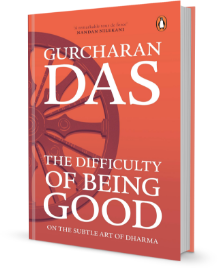
I shall be coming to America this fall. What brings me over is a twelve city book tour by Oxford University Press, who are publishing my new book, The Difficulty of Being Good: On the subtle art of dharma. I would genuinely like to meet my former collegues (as I have missed most of the reunions). I shall be visiting from September 20 to October 30. Here are the cities, I shall be visiting:

Continue reading…

Stranger At Home

August 15, 2010 on 12:58 pm | In Magazine, Outlook | No Comments

English bespeaks progress. India’s youth is much the worse without it.

Our obsession with the English language has served us brilliantly. It has kept us united as a nation; it has contributed significantly to the social mobility of Indians; it has been a major factor in our recent success in the global economy.

 One of the cheerful things happening in India is the quiet democratising of English. Dalits are today its biggest advocates because English allows them to work in call centres and other modern jobs where there are fewer caste barriers. A recent survey in Mumbai shows that Dalit women who knew English rose economically by marrying outside their caste–31% of Dalit women who knew English had inter-caste marriages compared to 9% who did not know the language. Dalits identify vernacular languages with caste oppression. Hence, Dalits across the country hailed Mayawati’s decision to introduce English from the first grade in U.P. (That there aren’t English teachers is another issue!) Continue reading…

Dharma in the public place

August 7, 2010 on 1:02 pm | In Business Standard, Newspapers | No Comments

Nothing is quite perfect in the world and certainly not human beings, as the Mahabharata reminds us. Our tendency to latch on to bad news at the expense of good news is unexcelled, and we tend to lose all balance in our judgements and miss out on the small victories of the day. Lalit Modi, the creator of the Indian Premier League of Cricket (IPL), has gone from being public hero to public enemy and this turnabout causes us some discomfort. If only we realized that dharma in the public place is different from private morality, we might be spared the confusion.     Continue reading…

Ayn Rand and I

August 3, 2010 on 6:10 pm | In Biblio, Magazine | No Comments

Ayn Rand and the world she made, Anne C. Heller, Tranquebar Press, Chennai, 2010,567 pages, Rs 495, ISBN 978 93 80658 01 8.

It is not easy to connect a writer’s life with her ideology.  Most biographers assume that there is an obvious and intimate connection and get on breezily with the job. Too often the connection turns out forced and the reader feels that she has been taken for a ride. Anne Heller’s excellent biography of the Ayn Rand is an exception. Her great achievement is to have connected Rand’s extraordinary legend and individualistic philosophy of unbridled capitalism to her life as a youngster, Alissa Zinovievna Rosenbaum, an awkward and wilful Russian Jewish prodigy, who had written four novels by the age of eleven. Heller makes you believe that  that Rand’s excessive self-absorption and vehement protest against any form of collectivism are rooted in her family’s suffering in early-twentieth-century Russia, where Jews were violently persecuted and personal freedom died when the communists came to power. Continue reading…

On moral luck and human vulnerability

July 3, 2010 on 2:03 pm | In Business Standard, Newspapers | No Comments

I was in Mumbai on that December night in 1984 when tragedy struck in Bhopal. I was head of an American multinational’s Indian subsidiary, a company not unlike Union Carbide, whose managing director also happened to be my friend. We were among a few foreign companies that had stayed on and had toughened under the punishing conditions of the ‘license-quota-permit raj’. I was in shock over the horrific human tragedy but my sadness came from another thought, ‘what if it had been me’? I placed myself in his shoes and wondered if I would have acted differently?  Probably not, and I thought about human vulnerability and how unbelievable lucky I was. Continue reading…

Private Affluence, Public Squalor

June 5, 2010 on 4:53 pm | In Business Standard, Newspapers | No Comments

 Recently on Karan Thapar’s program on television, a ‘stylish left wing’ commentator (SLW for short, a useful acronym that I owe to Saubhik Chakrabarti) said with a straight face that our troubles with the Maoists originated in our neo-liberal economic model and our post-1991obsession with growth. She then went on to lecture us about the callousness of the new middle class whose chief passion is vulgar consumption, and there is growing disparity between the rich and the poor.  Continue reading…

IPL and Capitalism

May 1, 2010 on 4:43 pm | In Business Standard, Newspapers | No Comments

 The recently concluded Indian Premier League (IPL) has been a non-stop party that lasted for six weeks to which everyone was invited provided you wanted to have fun. It brought magical nights to millions across India, a respite from their drab, desperate lives. It was filled to the brim with desire–for cricket and Bollywood, for chatter and glamour, for tomfoolery and unrequited sensuality, and for high rolling betting. (There was even satta market on the beleaguered Lalit Modi’s fate as the league commissioner, and the returns from every rupee on Mr Modi surviving were Rs 5.50 last Saturday.) Continue reading…

Don’t close down budget schools, give them graded recognition

April 3, 2010 on 4:08 pm | In Business Standard, Newspapers | 3 Comments

Unrecognised private schools, which cater to the poor in the slums and villages of India, have been under threat for a long time. With the passage of the Right to Education Act the threat is now real. The new law specifically calls for these schools to be closed or recognized within three years. In 2008, the Delhi High Court in 2008 had also wanted to close roughly 10,000 such schools in the national capital. Continue reading…

Entrepreneurs and Eggplant

March 8, 2010 on 3:27 pm | In Newspapers, Wall Street Journal | 5 Comments

  THE WALL STREET JOURNAL

OPINION ASI A
MARCH 8, 2010, 2:06 P.M. ET

Entrepreneurs and Eggplant

A case study in how India’s government is the main obstacle to economic progress.

By GURCHARAN DAS

New Delhi

Risk is built into capitalism because the rewards of investment arrive in the future. Risk usually comes from the unknown responses of customers and competitors in the marketplace. But in India, the greatest uncertainty still emanates from government and its overweening regulators, despite 18 years of economic reform. If anything holds India back from realizing its true potential, it is weak institutions of governance. Continue reading…

Remember, the money doesn’t belong to you!

February 1, 2010 on 12:04 pm | In Business Standard, Newspapers | 10 Comments

At a lunch party in Delhi recently I was confronted by a woman in a pink sari who effectively pinned me down while she lectured to me on the importance of corporate social responsibility. No one came to my rescue for ten minutes and I began to fret. I wondered how to get away from her without causing offence. Then I remembered some advice from a Bengali friend who had mentioned that in such situations a white lie is one’s best ally. So, I glanced over my overbearing tormentor’s shoulder as though someone had distracted me. I whispered loudly, ‘Coming, coming!’ to the imaginary person. Then I lied brazenly to my oppressor, ‘Ah, what a pity, I am being dragged away’ and I moved on shaking my head reluctantly. Continue reading…

Next Page »

Gurcharandas.Org site is Powered by WordPress with Pool Theme  managed by Center for Civil Society.
^Top^